MCP, Explained: The Universal Adapter for AI Agents (and Why It Matters for Salesforce)
“MCP” is suddenly everywhere in the Salesforce and AI world — and most explanations make it sound harder than it is. Here’s the plain-English version, and why it matters if you’re building agents.
The hype vs. the plain-English version
Every other post right now throws around “MCP” as if you’re supposed to already know what it means. Strip away the jargon and it’s a simple idea.
Think of MCP — the Model Context Protocol — as a universal power adapter for AI agents. Instead of building a custom cable for every device in every country, you agree on one standard socket, and everything plugs into it.
Before MCP vs. with MCP
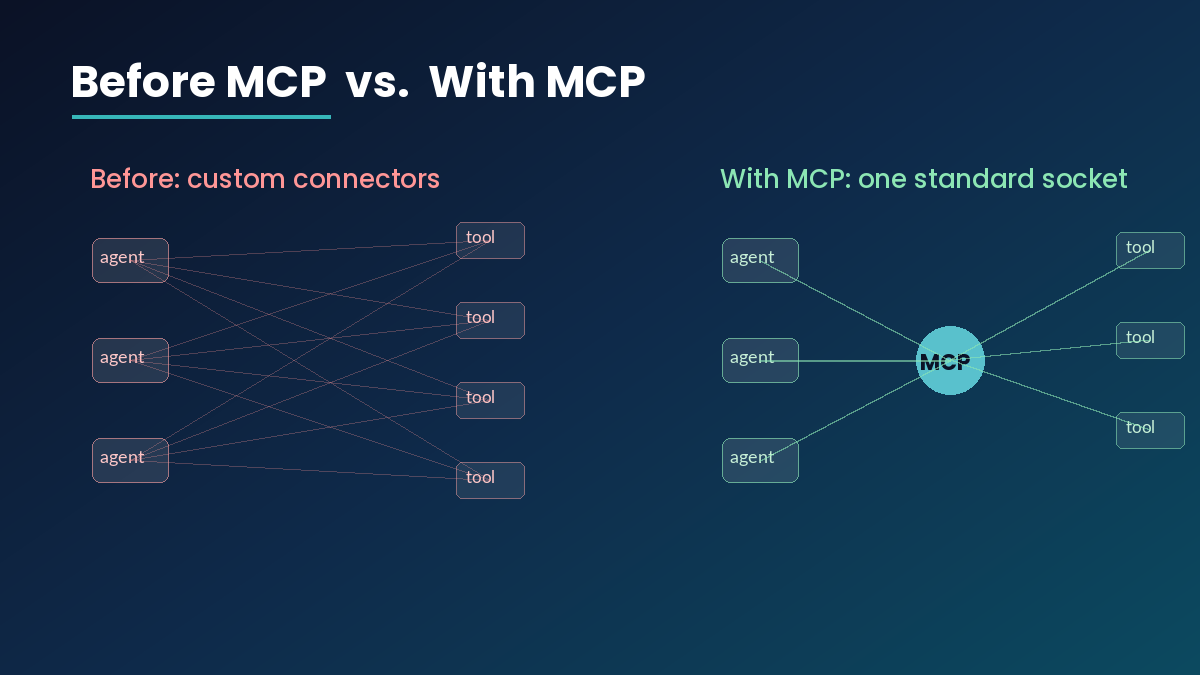
Before MCP: every time you wanted an agent to talk to a tool — Salesforce, a database, Slack, a ticketing system — someone hand-built a custom connector. Each one was bespoke, brittle, and broke the moment an API changed. Ten agents times ten tools meant a hundred fragile integrations to maintain.
With MCP: the tool exposes itself through one standard interface. Any agent — Agentforce, Claude, or whatever model comes next — plugs into the same socket. You build the connection once, and everything speaks the same language.
How it actually works
Under the hood, MCP defines a simple client–server relationship. An MCP server wraps a system (say, your CRM) and advertises what it can do: the tools it exposes (actions the agent can take) and the resources it can read (data the agent can ground on). An MCP client — the agent — discovers those tools and calls them through a standard contract, rather than through code written specifically for that one integration.
The important part for builders: the agent doesn’t need to know the messy internals of each system. It just needs to speak MCP. That’s what makes the whole thing composable.
Why builders should care
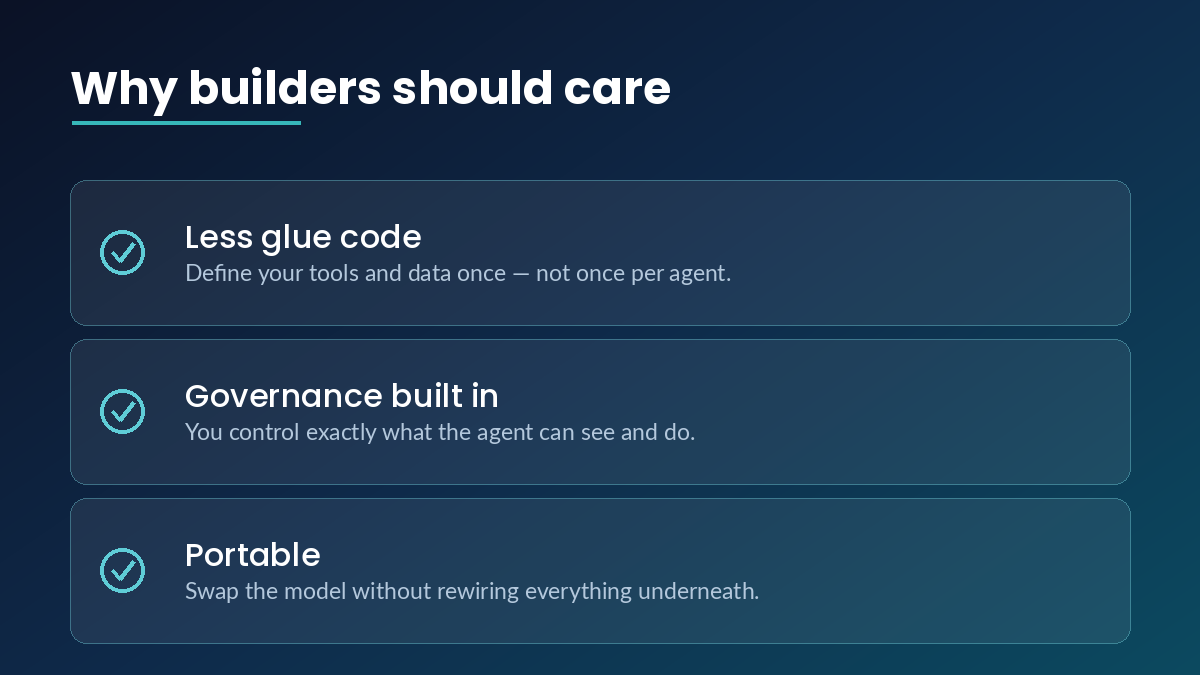
- Less glue code. You define your tools and data once, not once per agent. That’s less to build and far less to maintain.
- Governance built in. Because access flows through a defined interface, you control exactly what the agent can see and do. Scope is explicit, not scattered across custom scripts.
- Portable. Swap the underlying model without rewiring everything beneath it. Your integration layer outlives any single model choice.
MCP and Salesforce
This is where it gets practical for the Salesforce ecosystem. Salesforce now supports hosted MCP servers, so an agent can reach governed CRM context and actions through one clean interface instead of a pile of bespoke integrations. An Agentforce agent can use it internally, and an external model like Claude can connect to the same governed surface.
The result is the combination builders actually want: reach and governance at the same time. The agent can do more, through a contract you control.
What MCP doesn’t solve
One honest caveat. MCP is plumbing, not magic. It doesn’t replace good data hygiene or tight permissions — if anything, it makes them matter more. When your agent can suddenly reach further with less friction, clean grounding data and least-privilege access become the difference between a helpful agent and an expensive mistake. (We wrote about exactly that failure mode in our piece on why most Agentforce projects stall.)
The takeaway
If you’re building agents in 2026, MCP is the plumbing worth understanding. It won’t write your strategy for you, but it turns integration from a pile of one-off connectors into a maintainable, governable foundation — and that’s what lets you ship agents that last.
Shrine Software Services builds enterprise AI agents and Salesforce, Agentforce, Zoho, Java, and React solutions for clients across the US, UK, Australia, and India. Want to talk through where MCP fits in your stack? Let’s talk.